AI
How Large Language Models Are Reshaping Human Life
Large language models have evolved from experimental neural networks to billion-user platforms in just years, fundamentally transforming how people work, create, and solve problems—with AI companions, autonomous agents, and physical robotics representing the next wave of this accelerating revolution.
Two years ago, most people had never heard of a large language model. Today, ChatGPT has between 800 million and 1 billion weekly active users, and Nvidia—the company making the chips that power these AI systems—has reached a market capitalization of $4.459 trillion, making it the world’s most valuable company. We’re witnessing a technological shift that’s moving faster than the internet itself.
Let’s trace how we got here and where we’re headed.
The Foundation: A Brief Technical History
Neural Networks: The Beginning (1950s-2010s)
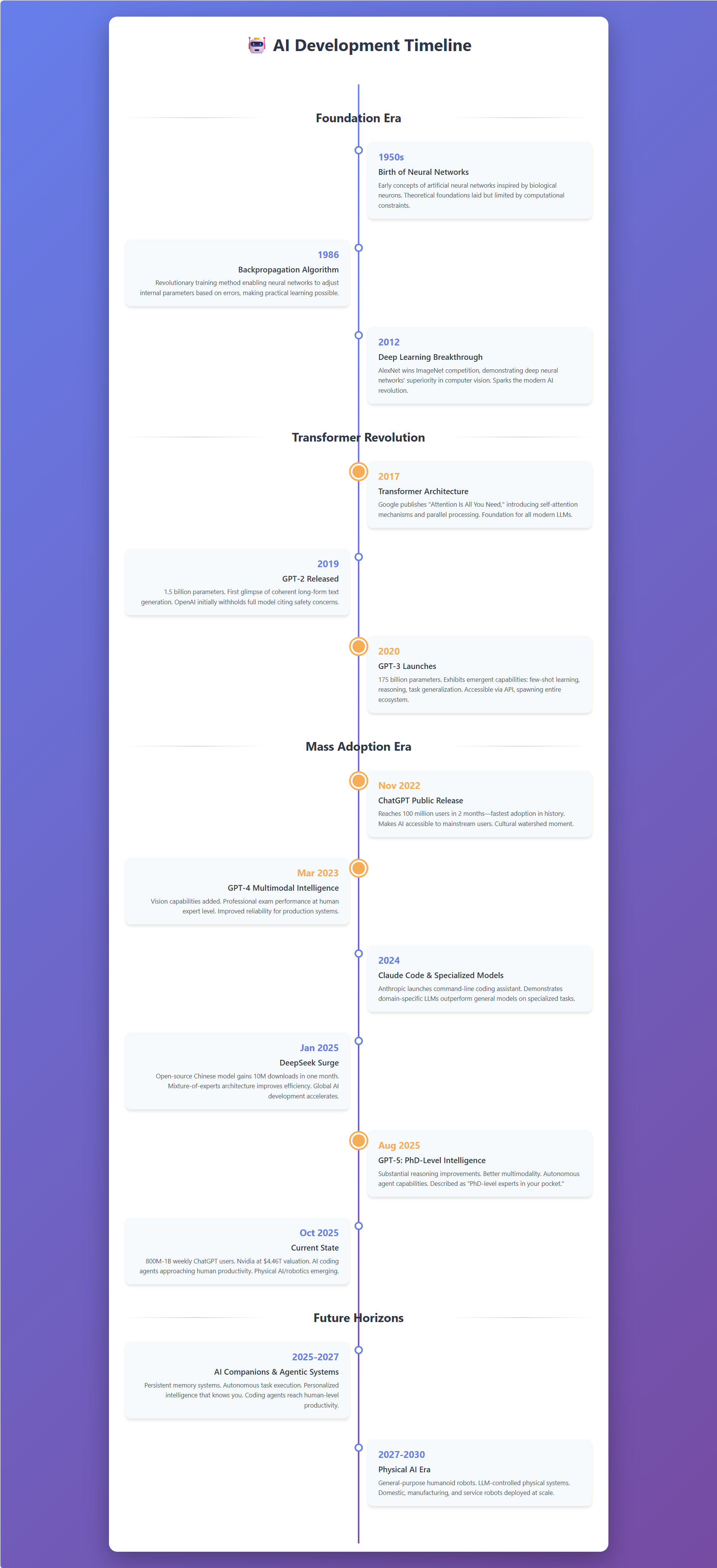
The concept of artificial neural networks emerged in the 1950s, inspired by biological neurons. Early implementations were limited by computational power and data availability. The fundamental idea—that interconnected nodes could learn patterns through training—remained largely theoretical for decades.
The breakthrough came with backpropagation in the 1980s, enabling networks to adjust their internal parameters based on errors. But neural networks remained niche tools, overshadowed by other machine learning approaches, until the 2010s brought sufficient compute power and data to make them practical.
The Transformer Architecture (2017)
Google researchers published “Attention Is All You Need” in 2017, introducing the Transformer architecture. This wasn’t just an incremental improvement—it fundamentally changed how models process sequential data.
Key innovations:
- Self-attention mechanisms that allow the model to weigh the importance of different parts of the input simultaneously
- Parallel processing replacing sequential RNN architectures, enabling massive scaling
- Positional encoding that maintains sequence order information without sequential processing
The Transformer made it possible to train models on unprecedented scales of data with reasonable computational efficiency. Every major LLM today—GPT, Claude, Gemini, DeepSeek—uses Transformer-based architectures.
GPT-2: The First Hint of What Was Possible (2019)
OpenAI’s GPT-2 demonstrated that scaling Transformers produced surprisingly coherent text generation. With 1.5 billion parameters, it could write convincing articles, answer questions, and even generate code.
OpenAI initially withheld the full model, citing concerns about misuse—a decision that sparked debate but also signaled something important: these models were becoming powerful enough to matter.
GPT-3: Crossing the Capability Threshold (2020)
GPT-3 changed everything. At 175 billion parameters, it exhibited emergent capabilities that smaller models lacked: few-shot learning, reasoning chains, and task generalization without specific training.
Developers discovered they could build applications simply by crafting prompts—no fine-tuning required. This accessibility democratized AI development and spawned an ecosystem of tools built on GPT-3’s API.
GPT-4: Multimodal Intelligence (2023)
GPT-4 introduced vision capabilities alongside significant reasoning improvements. It could analyze images, charts, and diagrams. Performance on professional exams (bar exam, medical licensing, etc.) reached human expert levels.
More importantly, GPT-4 demonstrated reliability improvements that made it viable for production systems. Error rates decreased, instruction-following improved, and hallucinations reduced—though not eliminated.
GPT-5: The Intelligence Leap (August 2025)
Released in August 2025, GPT-5 represents OpenAI’s smartest, fastest, and most useful model yet, described by CEO Sam Altman as “having a team of PhD-level experts in your pocket”. The model demonstrates substantial improvements in reasoning, multimodality, and agent-style task execution.
Early benchmarks show GPT-5 excelling at complex problem-solving, particularly in programming, mathematics, and scientific reasoning. The model’s ability to maintain context and execute multi-step tasks autonomously marks a shift from chat interface to autonomous agent.
Claude Code: Specialized Development Intelligence (2024-2025)
Anthropic’s Claude Code represents a different approach: highly specialized capability for software development tasks. Rather than general-purpose chat, Claude Code operates as a command-line tool for autonomous coding.
The system can:
- Understand codebases spanning multiple files and dependencies
- Implement features across an entire project autonomously
- Debug complex issues by analyzing stack traces and logs
- Refactor code while maintaining functionality
- Write tests and documentation
Claude Code demonstrates that specialized LLMs tuned for specific domains can outperform general-purpose models on those tasks.
DeepSeek: The Open Alternative (2024-2025)
DeepSeek emerged from China as a competitive open-source alternative to Western models. The platform gained 10 million downloads in January 2025 alone, demonstrating both the global nature of LLM development and growing demand for alternatives to OpenAI’s ecosystem.
DeepSeek’s architecture incorporates mixture-of-experts (MoE) approaches, activating only relevant subsets of the model for each query. This improves computational efficiency—a critical factor as models scale beyond trillions of parameters.
The Transformation of Everyday Life
Adoption Velocity: Unprecedented Scale
ChatGPT reached 100 million users in less than two months after launch—faster than any consumer application in history. For context, Instagram took 2.5 years to reach the same milestone. The mobile app alone has over 500 million downloads on Google Play.
This adoption velocity reflects genuine utility. People aren’t experimenting with ChatGPT—they’re integrating it into daily workflows.
How People Actually Use LLMs
20% of adults in the U.S. now use ChatGPT for work-related tasks. The applications span:
Professional Work:
- Drafting emails, reports, and documentation
- Code generation and debugging
- Data analysis and visualization
- Research synthesis and literature review
- Meeting summaries and action items
Creative Applications:
- Content ideation and brainstorming
- Writing assistance for articles, scripts, and stories
- Design concepts and visual mockups
- Music composition and sound design
Personal Assistance:
- Learning new subjects through interactive tutoring
- Trip planning with real-time recommendations
- Recipe development and meal planning
- Health information research (though not medical advice)
Educational Use:
- Homework assistance and concept explanation
- Language learning with conversational practice
- Test preparation with customized question sets
- Research project guidance
The pattern across these use cases: LLMs handle the cognitively demanding but not creatively distinctive work, freeing humans for higher-order thinking.
The Economic Signal: Nvidia’s Valuation
Nvidia’s $4.459 trillion market capitalization represents a 46.91% increase in just one year. This isn’t speculation—it reflects real demand for AI infrastructure.
Organizations are investing billions in GPU clusters to train and deploy models. Microsoft, Google, Meta, and Amazon are each spending tens of billions annually on AI infrastructure. This capital deployment indicates institutional belief that LLMs represent fundamental technological shift, not a temporary trend.
The semiconductor constraint has become the primary bottleneck in AI development. Nvidia’s H100 and upcoming B200 GPUs are allocated years in advance. This scarcity is driving innovation in model efficiency, quantization techniques, and alternative architectures that require less compute.
The Future: Three Vectors of Development
1. AI Companions: Personalized Intelligence
Current LLMs are stateless—they don’t truly remember you across sessions. The next generation will maintain persistent memory, learning your preferences, communication style, and needs over time.
Imagine an AI assistant that:
- Knows your work projects, deadlines, and priorities
- Understands your decision-making patterns and can offer genuinely personalized advice
- Maintains relationships context (remembering details about your colleagues, family, friends)
- Adapts its communication style to match yours
- Proactively offers assistance based on context awareness
This isn’t science fiction. The technical components exist—persistent vector databases, embedding-based memory systems, and fine-tuning on individual interaction patterns. The challenge is building this responsibly with proper privacy controls.
Companies like Anthropic, OpenAI, and emerging startups are racing to ship companion AI that feels less like a tool and more like a collaborator who actually knows you.
2. Agentic AI: Autonomous Task Execution
Current LLMs require human initiation for each task. Agentic AI operates autonomously toward defined goals.
Coding Agents are the most advanced current implementation:
- Autonomous debugging that identifies issues, researches solutions, implements fixes, and validates results
- Feature development from specification to production-ready code
- Codebase refactoring that touches hundreds of files consistently
- Test suite generation with edge case coverage
Tools like Claude Code, GitHub Copilot Workspace, and Devin demonstrate coding agents approaching human developer productivity on well-defined tasks. The constraint isn’t capability—it’s trust. Organizations are gradually expanding the autonomy granted to these systems as reliability improves.
Beyond Coding:
- Research agents that identify questions, gather sources, synthesize findings, and produce reports
- Sales agents that qualify leads, schedule meetings, and maintain follow-up sequences
- Content agents that research topics, generate drafts, fact-check, and publish
- Business intelligence agents that monitor metrics, identify anomalies, and recommend actions
The pattern: any workflow involving information processing, decision-making, and tool use is becoming automatable.
3. Physical AI: Intelligence Meets Robotics
LLMs provide the “brain” for physical systems. Combining vision models, language understanding, and robotics control enables machines that understand and manipulate the physical world.
Current Progress:
- Warehouse robots using vision LLMs to identify and sort arbitrary objects
- Humanoid robots (Tesla Optimus, Figure, Boston Dynamics) controlled by LLM-based planning systems
- Autonomous vehicles using transformer-based perception and decision-making
- Surgical robots with AI-assisted planning and execution
Near-Term Applications:
- Domestic robots that can clean, organize, and maintain homes based on natural language instructions
- Agricultural robots that identify plant health, target treatments, and harvest autonomously
- Manufacturing systems that adapt to product variations without reprogramming
- Construction robots that work from architectural plans without explicit task programming
The technical challenge is connecting high-level reasoning (LLMs) with low-level motor control (robotics). Success requires:
- Real-time perception and world modeling
- Physical understanding (weight, friction, balance)
- Safety systems preventing harmful actions
- Manipulation dexterity for handling diverse objects
Companies like Tesla, Figure AI, Sanctuary AI, and 1X are racing toward general-purpose humanoid robots within 3-5 years. Unlike previous robotics efforts, these systems leverage pre-trained LLMs rather than task-specific programming.
What This Means for You
The LLM revolution isn’t coming—it’s here. 800 million to 1 billion people are already using these systems weekly. Within five years, interacting with AI will be as routine as using a search engine today.
The question isn’t whether AI will change your work and life, but how you’ll adapt to leverage it. Early adopters are already seeing productivity multipliers. Those who learn to collaborate effectively with AI assistants, deploy agentic workflows, and think architecturally about automation will have significant advantages.
The technology is evolving faster than social institutions can adapt. Education systems, labor markets, regulatory frameworks, and social norms are all lagging the technical reality. We’re collectively figuring out how to integrate intelligence-on-demand into civilization.
It’s messy, it’s uncertain, and it’s incredibly exciting.
The models mentioned in this post are continuously evolving. By the time you read this, capabilities will likely have advanced further. The trajectory is clear: more capable, more accessible, more integrated into daily life.
My Amazon Picks
As an Amazon Associate I earn from qualifying purchases.
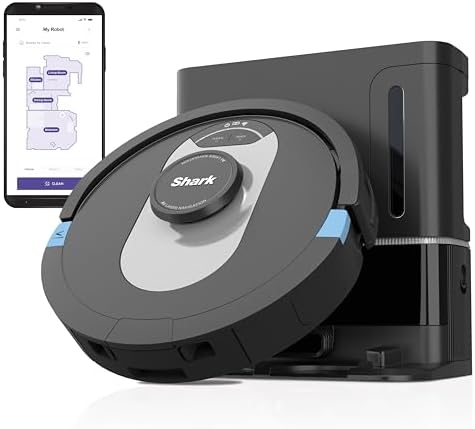
Shark AI Ultra Robot Vacuum
Matrix Clean charts every room, grabs the mess, then offloads dust into a 60-day HEPA self-empty base.
- Hands-free scheduling and voice/app control with precise home mapping.
- Anti-allergen filtration traps pet dander while the self-empty dock handles the bin.
Join the discussion
Thoughts, critiques, and curiosities are all welcome.