AI
Understanding Agentic Workflows: Beyond Traditional Automation
A friendly intro to agentic AI—what it is, how it differs from classic automation, and a n8n example to get started.
Agentic AI isn’t magic—it’s just automation that can decide what to do next. Instead of marching down a fixed flow, an agent can reason, pick a tool, and try again if the first attempt flops. That tiny bit of autonomy is why it feels different from old-school “if this then that.”

Automation has evolved. What started as simple rule-based systems executing predetermined sequences has transformed into something far more sophisticated: agentic workflows. These systems don’t just follow instructions—they make decisions, adapt to context, and operate autonomously with minimal human intervention.
Let’s explore what makes them different and why they matter.
Defining Agentic Workflows
Traditional automation operates on fixed logic: if condition A occurs, execute action B. It’s deterministic, predictable, and limited to scenarios you’ve explicitly programmed.
Agentic workflows introduce intelligence into this equation. They leverage large language models (LLMs) and AI systems to:
- Analyze context dynamically rather than following static rules
- Make informed decisions based on current data and goals
- Adapt their behavior to changing conditions
- Coordinate multiple tools and APIs to achieve objectives
- Maintain state and memory across interactions
The architecture typically consists of four key components:
- AI Models (GPT-5, Claude, etc.) – The decision-making core that interprets context and determines actions
- Tool Integration Layer – APIs, databases, and services the agent can interact with
- Orchestration Logic – The framework that coordinates agent behavior and enforces constraints
- Memory Systems – Context storage that enables the agent to maintain continuity across sessions
What makes these workflows “agentic” is their autonomy. Once initialized, they can operate independently, making real-time decisions without constant human input.
A Practical Example: Autonomous LinkedIn Content Generation
Theory is useful, but let’s examine a concrete implementation. Consider the challenge of maintaining consistent LinkedIn presence—a task that typically consumes 15+ hours weekly for professionals who take content seriously.
The Problem Space
Creating quality LinkedIn content involves several cognitively demanding tasks:
- Identifying trending topics with remaining relevance windows
- Researching angles that resonate with your specific audience
- Writing in an authentic voice that reflects your expertise
- Generating visual content that enhances engagement
- Managing a consistent publishing schedule
Each step requires judgment calls. That makes this an ideal candidate for an agentic approach.
Architecture: The n8n LinkedIn Content Workflow
The Automated LinkedIn Content Creation workflow demonstrates how to build a practical agentic system using n8n as the orchestration platform.
Component 1: Intelligent Topic Research
Rather than selecting from a predetermined topic list, the workflow uses GPT-4 to actively analyze current industry trends. The agent queries recent discussions, identifies emerging themes, and evaluates which angles have engagement potential. This is true agentic behavior—the system is making strategic decisions about content direction, not just executing a template.
Component 2: Voice-Aware Content Generation
The workflow maintains a prompt configuration that captures your writing patterns, industry expertise, and audience expectations. GPT-4 then generates posts that align with these parameters. The key technical detail here is prompt engineering: you’re essentially teaching the agent your voice through examples and constraints, creating a consistent output style without manual writing.
Component 3: Automated Visual Generation
DALL-E integration handles image creation based on content themes. The workflow doesn’t rely on stock photo databases—it generates custom visuals aligned with your post’s specific message and brand aesthetic. This requires the agent to parse post content, extract visual themes, and construct appropriate image generation prompts.
Component 4: Scheduling and Publication
The workflow interfaces with LinkedIn’s API to handle publication timing. You define your posting cadence (daily, weekly, custom intervals), and the system manages the queue autonomously. This includes handling API rate limits, retry logic for failed posts, and error notifications.
Component 5: Optional Human Review
For scenarios requiring editorial oversight, the workflow supports approval gates. Content is generated and staged, then routed for human review before publication. This hybrid approach provides safety while maintaining most of the efficiency gains.
Measured Outcomes
Users implementing this workflow report quantifiable results:
- Content output increased from ~12 to 120+ posts monthly (10x improvement)
- Profile views increased by 400% within three weeks
- Time investment reduced from 15+ hours to approximately 1 hour weekly (for review)
- Engagement consistency improved due to reliable posting schedule
The operational cost is approximately $5-15 monthly in OpenAI API fees, driven primarily by GPT-4 and DALL-E usage.
Technical Implementation Details
The n8n Non-Code Workflow
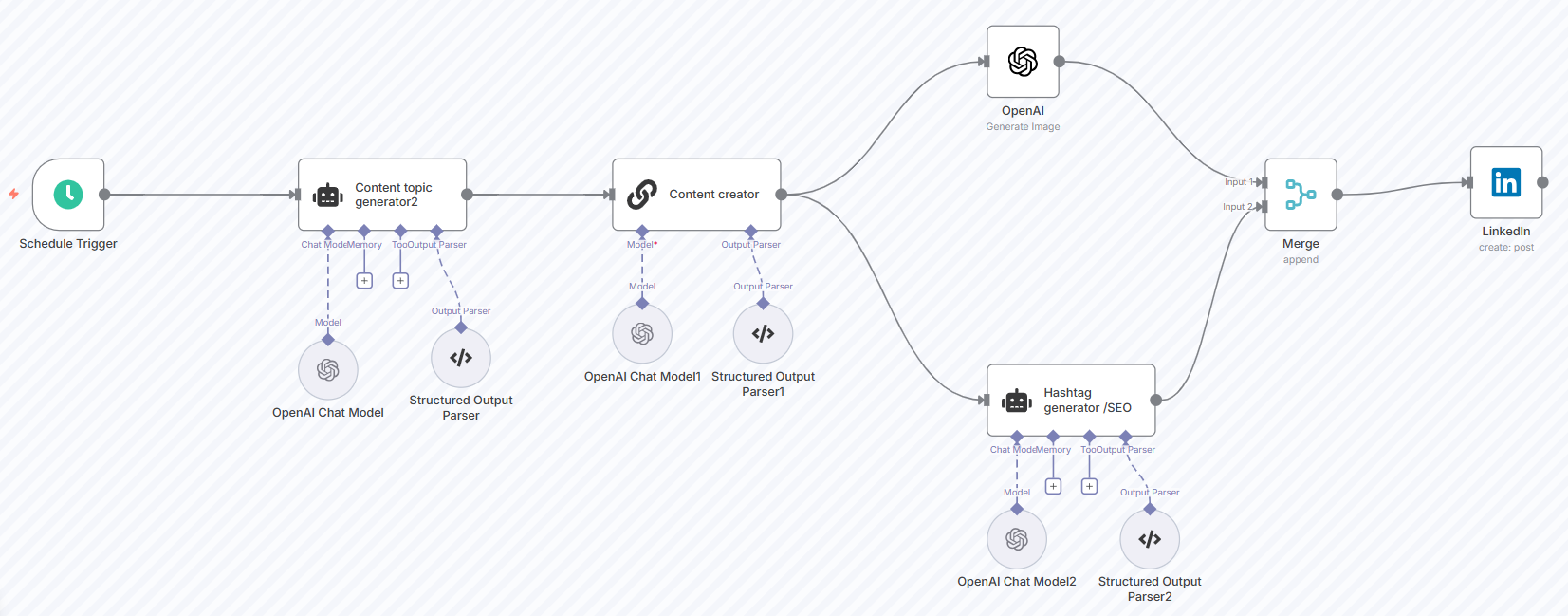
Required Infrastructure:
- OpenAI API access – For GPT-4 text generation and DALL-E image synthesis
- LinkedIn API credentials – For programmatic post publishing
- n8n platform – Open-source workflow automation (self-hosted or cloud)
- Webhook or scheduler – To trigger workflow execution
Setup Requirements:
- Time investment: 30-45 minutes for initial configuration
- Technical skill level: Intermediate (requires API credential management and workflow logic)
- Infrastructure: Can run on minimal compute (1 CPU, 2GB RAM for self-hosted n8n)
Why n8n?
n8n provides visual workflow building with node-based architecture. You’re connecting components graphically rather than writing integration code from scratch. However, it includes JavaScript execution nodes when you need custom logic, giving you flexibility without forcing you into pure code or pure no-code extremes.
The Broader Pattern: Where Agentic Workflows Apply
This LinkedIn example represents a pattern applicable across domains:
Customer Support: Agents that triage tickets, search knowledge bases, draft responses, and escalate only when necessary. The agent maintains conversation context and makes routing decisions autonomously.
Content Pipelines: Systems that research topics, generate drafts, fact-check against sources, optimize for SEO, and publish—handling the entire pipeline with decision points at each stage.
Sales Automation: Agents that qualify inbound leads based on conversation analysis, schedule meetings by checking calendars, and maintain follow-up sequences adapted to prospect behavior.
Development Workflows: Code generation systems that write implementations, execute tests, analyze failures, iterate on fixes, and create pull requests when tests pass.
The common thread: tasks requiring judgment and coordination across multiple tools, but not requiring human-level strategic thinking for every decision.
Implementation Considerations
When to Build Agentic Workflows:
Build agents for tasks that are:
- Time-consuming and repetitive
- Requiring decisions but following learnable patterns
- Involving multiple tool interactions
- Currently blocking your higher-value work
When to Stay Manual:
Keep human control for:
- High-stakes decisions with significant consequences
- Tasks requiring nuanced judgment you can’t easily specify
- Novel situations the agent hasn’t been trained to handle
- Processes still being defined and likely to change frequently
Starting Safely:
Begin with human-in-the-loop configurations. Let the agent generate and propose, while you review and approve. As you build confidence in its decision-making, gradually remove approval gates for lower-risk actions.
Looking Forward
Agentic workflows represent a fundamental shift in how we think about automation. We’re moving from “automate this specific sequence” to “achieve this objective using whatever approach makes sense given current context.”
The technology is accessible now. The question isn’t whether agentic workflows are viable—it’s identifying which of your repetitive, decision-laden tasks to automate first.
The n8n LinkedIn workflow template is production-ready and documented. If LinkedIn content is consuming your time, this is worth 45 minutes of setup.
My Amazon Picks
As an Amazon Associate I earn from qualifying purchases.
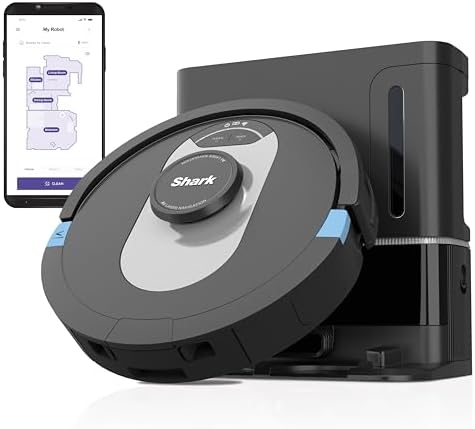
Shark AI Ultra Robot Vacuum
Matrix Clean charts every room, grabs the mess, then offloads dust into a 60-day HEPA self-empty base.
- Hands-free scheduling and voice/app control with precise home mapping.
- Anti-allergen filtration traps pet dander while the self-empty dock handles the bin.
Join the discussion
Thoughts, critiques, and curiosities are all welcome.