Space Tech
Physics Wins: Why Software Can't Save Starlink From High-Power Jamming
A deep technical analysis of anti-jamming countermeasures—adaptive beamforming, frequency hopping, error correction—and the fundamental RF physics that limits their effectiveness against near-field, high-power interference.

In January 2026, Iran launched what experts call the most sophisticated electronic warfare attack ever conducted against a commercial satellite constellation. Starlink terminals across the country experienced 80% packet loss. Connection rates in urban protest hotspots flatlined. And despite SpaceX’s rapid deployment of software countermeasures, one expert’s assessment cut through the technical optimism with brutal clarity.
Carlos Perez, a security expert quoted in the New York Sun’s analysis, explained the fundamental limitation:
“If someone parks a multi-kilowatt jammer 100 meters from your terminal broadcasting across the entire Ku-band, no amount of clever software is saving that link. Physics wins.”
This statement deserves unpacking. SpaceX has some of the world’s best RF engineers. Their terminals employ sophisticated adaptive beamforming, spread spectrum techniques, and advanced error correction. Yet Perez asserts these countermeasures have hard limits.
He’s right. And understanding why requires diving into the math that governs radio propagation, signal processing, and the fundamental asymmetry between a satellite 550 km away and a jammer 100 meters down the street.
The Timeline: Iran’s Assault and SpaceX’s Response
January 8, 2026: The Blackout Begins
As protests intensified across Iran, the regime initiated a total communications blackout. Unlike previous shutdowns that targeted terrestrial infrastructure, this operation specifically attacked Starlink—the satellite service that had become protesters’ last resort for uncensored communication.
The attack employed a multi-vector kill chain:
-
GPS spoofing: Starlink terminals require GPS signals to locate themselves and orient their phased-array antennas. By spoofing GPS, Iranian authorities rendered terminals unable to determine their position—and thus unable to point at the correct satellites.
-
Ku-band saturation: Military-grade RF jammers flooded the 12–18 GHz frequencies Starlink uses for user uplink and downlink, overwhelming legitimate signals.
-
Mobile deployment: Unlike fixed installations, Iranian jamming units were vehicle-mounted, allowing dynamic targeting of protest hotspots.
The result: 80% packet loss in heavily targeted areas, with nationwide degradation hovering around 30%.
January 13, 2026: SpaceX’s Software Update
Five days later, SpaceX deployed a critical software update. The patch enabled Starlink terminals to triangulate position using Starlink signals themselves, bypassing the spoofed GPS entirely. Packet loss in some areas dropped from 80% to approximately 10%.
This was an impressive engineering response. But it addressed only one attack vector—the GPS spoofing component. Against the direct Ku-band jamming, software improvements yielded more modest gains.
The Perez Assessment
Victoria Samson of the Secure World Foundation noted that the terminals’ GPS units were being spoofed, causing them to “think they were physically somewhere they were not.” SpaceX’s GPS-free positioning addressed this specific vulnerability.
But Perez’s comment addressed a different problem: what happens when a powerful jammer is physically close to your terminal, broadcasting raw RF energy across your entire receive band. Here, software countermeasures face fundamental physical limits.
Let’s examine those countermeasures—and where they break down.
Software Countermeasure #1: Adaptive Beamforming and Null Steering
How It Works
Starlink terminals use phased-array antennas—arrays of small antenna elements whose signals are combined electronically. By adjusting the phase and amplitude of each element’s contribution, the system can:
- Steer the main beam toward the desired satellite
- Create nulls—points of zero sensitivity—toward interference sources
This process, called adaptive null steering, is perhaps the most powerful software-based anti-jamming technique available.
The mathematics are elegant. If you have N antenna elements, you can independently steer N-1 nulls toward different interference sources. For each null, the system measures the angle of arrival of the interfering signal, then computes beamforming weights that destructively combine the jammer’s signal to near-zero while preserving the satellite signal.
What It Can Achieve
According to GPS World’s analysis, adaptive arrays can provide:
- 15 to 90 dB of jamming rejection depending on architecture
- Null depths of -113 dB under controlled conditions
- Effective cancellation of N-1 jammers for an N-element array
For reference, 40 dB of rejection means the jammer’s effective power is reduced by a factor of 10,000. A 1 kW jammer becomes equivalent to 100 mW from the receiver’s perspective.
This is substantial. Against a distant, moderate-power jammer, null steering can absolutely save the link.
Where It Fails
But there are hard limits:
1. Sidelobe Leakage
No antenna pattern is perfect. Every beam has sidelobes—unintended directions where the antenna retains some sensitivity. A sufficiently powerful jammer can blast energy into these sidelobes, bypassing the null.
The physics: a typical phased array might achieve 30 dB suppression of its first sidelobe. A jammer positioned in that sidelobe direction would need to be 30 dB (1000×) weaker than one in the main beam direction to have equivalent effect. But a multi-kilowatt jammer has power to spare.
2. Near-Field Dominance
Null steering assumes the jammer is in the far field—far enough that it appears as a point source with a well-defined angle of arrival. Within the near field (roughly within a few wavelengths of the antenna), the jammer’s signal doesn’t arrive from a single direction. It illuminates the array non-uniformly. Null steering calculations, which assume planar wavefronts, break down.
At Ku-band (12–18 GHz), wavelength is roughly 2 cm. A jammer 100 meters away is well within the far field. But the principle matters: as the jammer gets closer, geometric effects increasingly favor the jammer.
3. The Power Budget Problem
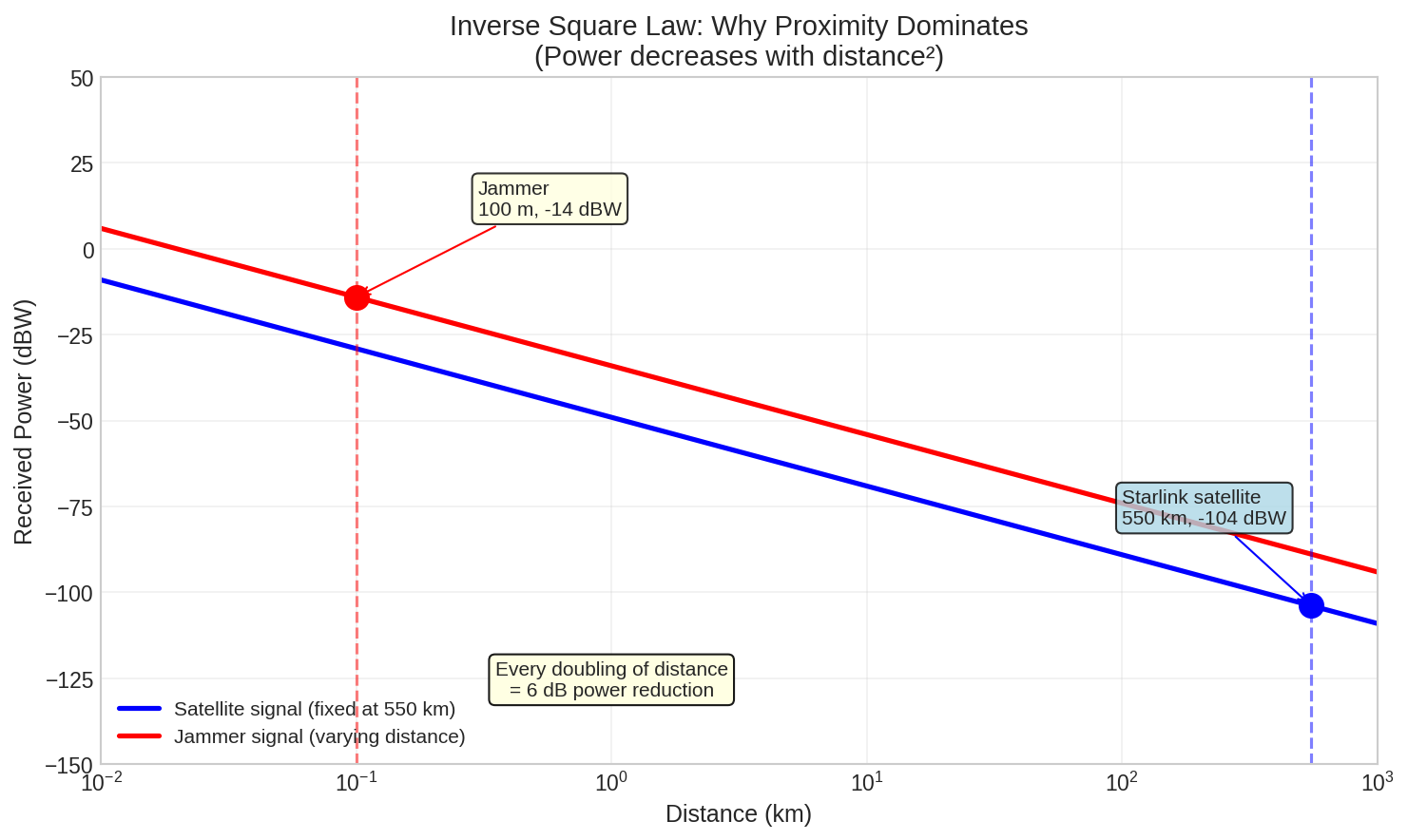
Here’s the core issue. The satellite signal arrives from 550 km altitude. The jammer is 100 meters away. Let’s do the math.
Radio signal strength follows the inverse square law: power density decreases with the square of distance. The ratio of distances is:
550,000 m ÷ 100 m = 5,500×
The ratio of received power densities scales with distance squared:
(5,500)² = 30,250,000×
In decibels: 10 × log₁₀(30,250,000) ≈ 74.8 dB
This means a ground-based jammer at 100 meters enjoys a ~75 dB advantage over the satellite signal purely from proximity—before considering antenna gains or transmit powers.
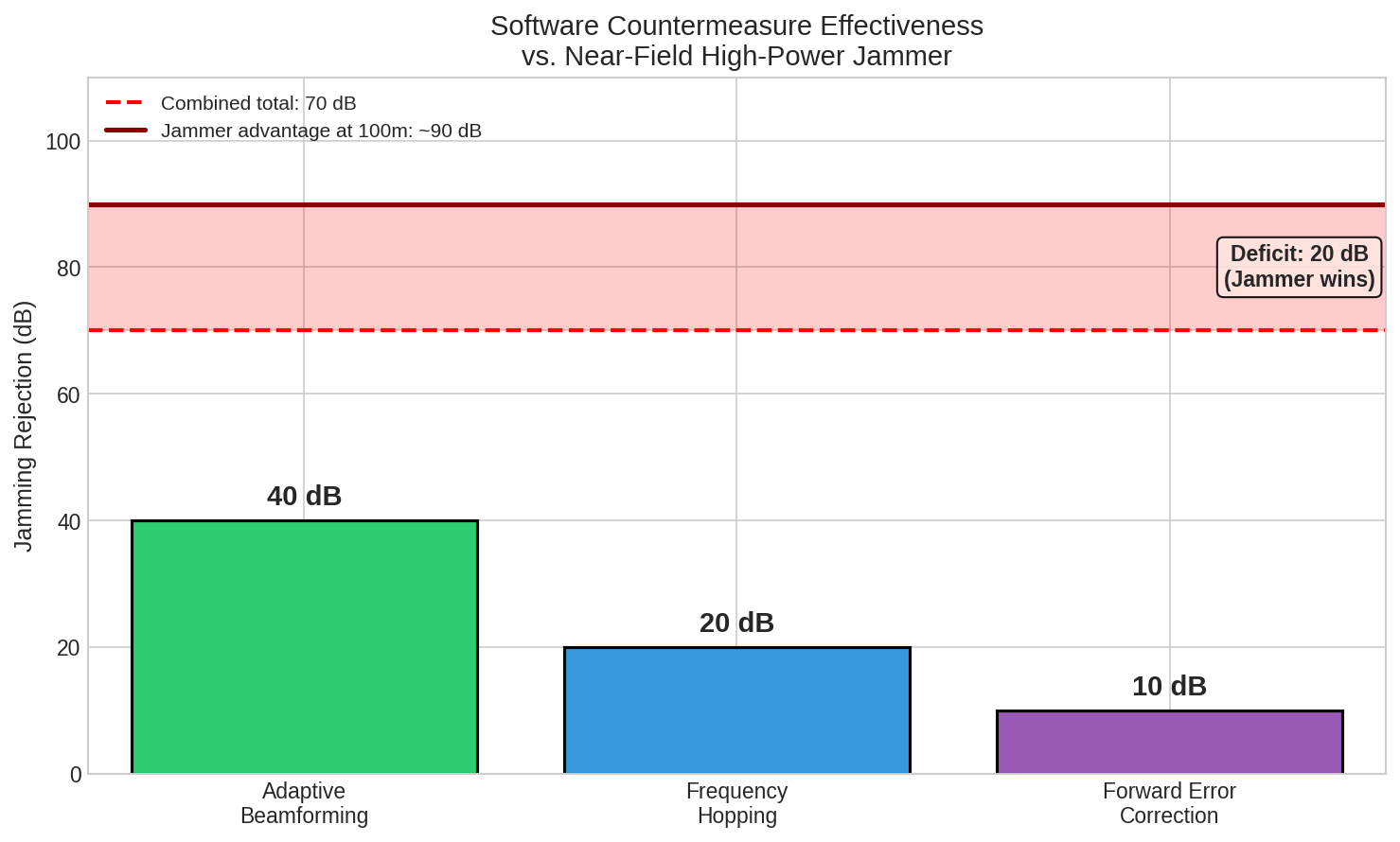
Even if null steering achieves 40 dB of jammer rejection, you’re still 35 dB underwater. The jammer wins.
Software Countermeasure #2: Frequency Hopping Spread Spectrum
How It Works
Frequency Hopping Spread Spectrum (FHSS) distributes the signal across a wide frequency band by rapidly switching (“hopping”) between narrowband channels. The hopping pattern is determined by a pseudorandom sequence known only to the transmitter and receiver.
A jammer faces a dilemma:
- Follow the hops: Requires knowing the secret hopping pattern. Without it, the jammer can’t predict where the signal will be next.
- Jam the entire band: Spreads the jammer’s power across all possible hop frequencies, weakening its effect at any single frequency.
The receiver gains a processing gain from spread spectrum:
Gₚ = 10 × log₁₀(Spread Bandwidth / Data Bandwidth)
If the spread bandwidth is 100× the data bandwidth, the receiver enjoys 20 dB of processing gain—effectively making the jammer 100× less effective.
What It Can Achieve
Typical spread spectrum systems achieve processing gains of 10 to 60 dB. Against a narrowband jammer targeting a specific frequency, this is highly effective—the signal hops away before the jammer can track it.
Against an adversary without knowledge of the hopping sequence, FHSS provides robust protection.
Where It Fails
1. Wideband Jamming
If the jammer simply broadcasts across the entire band simultaneously, it doesn’t need to follow the hops. Every frequency the signal lands on is already jammed.
The tradeoff: spreading jammer power across a wider bandwidth reduces power per Hz. But if the jammer has sufficient total power, it can achieve effective jamming density across the entire band.
Consider Ku-band: Starlink uses roughly 500 MHz of bandwidth. A 10 kW jammer spread across 500 MHz delivers 20 W/MHz—or +43 dBm/MHz. Compare to the Starlink signal arriving at roughly -100 dBm (estimated), and the jammer still dominates by enormous margins.
2. Hardware Limitations
As Rohde & Schwarz notes, FHSS performance is often limited by analog hardware constraints:
- Settling time: How quickly can the synthesizer switch frequencies? Slow switching creates vulnerable windows.
- Group delay variation: Different frequencies may have different propagation delays through the system, causing distortion.
- Front-end selectivity: Components may not perform uniformly across the entire hopping bandwidth.
These factors limit achievable hopping speed and, consequently, jamming resistance.
3. Synchronization Under Attack
FHSS requires the receiver to track the hopping pattern in synchronization with the transmitter. Under heavy interference, the receiver may lose sync—and once lost, re-acquisition itself requires a known signal, which the jammer is obscuring.
Software Countermeasure #3: Forward Error Correction
How It Works
Forward Error Correction (FEC) adds redundancy to transmitted data, allowing the receiver to reconstruct corrupted bits without retransmission. Common codes include Reed-Solomon, LDPC (Low-Density Parity Check), and Turbo codes.
FEC provides coding gain: the improvement in Signal-to-Noise Ratio (SNR) needed to achieve a target Bit Error Rate (BER) compared to uncoded transmission.
What It Can Achieve
Modern FEC codes achieve impressive coding gains:
| Code Type | Overhead | Net Coding Gain |
|---|---|---|
| RS(255,239) | 7% | 5.8 dB |
| Concatenated BCH | 10% | 8.5 dB |
| Soft-decision TPC | 15% | 10.3 dB |
| SC-LDPC | 25% | 11.3 dB |
An 11 dB coding gain means the receiver can tolerate a signal that’s 11 dB weaker (or noise that’s 11 dB stronger) and still achieve the same error rate.
Against marginal interference—where the signal is barely usable—FEC can make the difference between connected and disconnected.
Where It Fails
1. Threshold Effects
FEC codes have cliff effects. Above a certain error rate, the code works beautifully. Below that threshold, it fails catastrophically—no graceful degradation.
If jamming pushes the pre-FEC BER beyond the code’s correction capability (typically around 10⁻² to 10⁻³ for modern codes), FEC provides no benefit. You don’t get partial service; you get no service.
2. Information-Theoretic Limits
Shannon’s channel capacity theorem sets a fundamental ceiling. No amount of coding can achieve reliable communication below a minimum SNR determined by bandwidth and required data rate:
C = B × log₂(1 + SNR)
If the jammer pushes SNR below the Shannon limit for your target data rate, no FEC scheme—no matter how sophisticated—can recover the data. The information simply isn’t there.
3. Modest Gains vs. Massive Deficits
FEC provides maybe 10 dB of improvement. Against a jammer that’s 40+ dB stronger than the desired signal, 10 dB doesn’t move the needle.
The Math: Why Multi-Kilowatt Jamming Always Wins
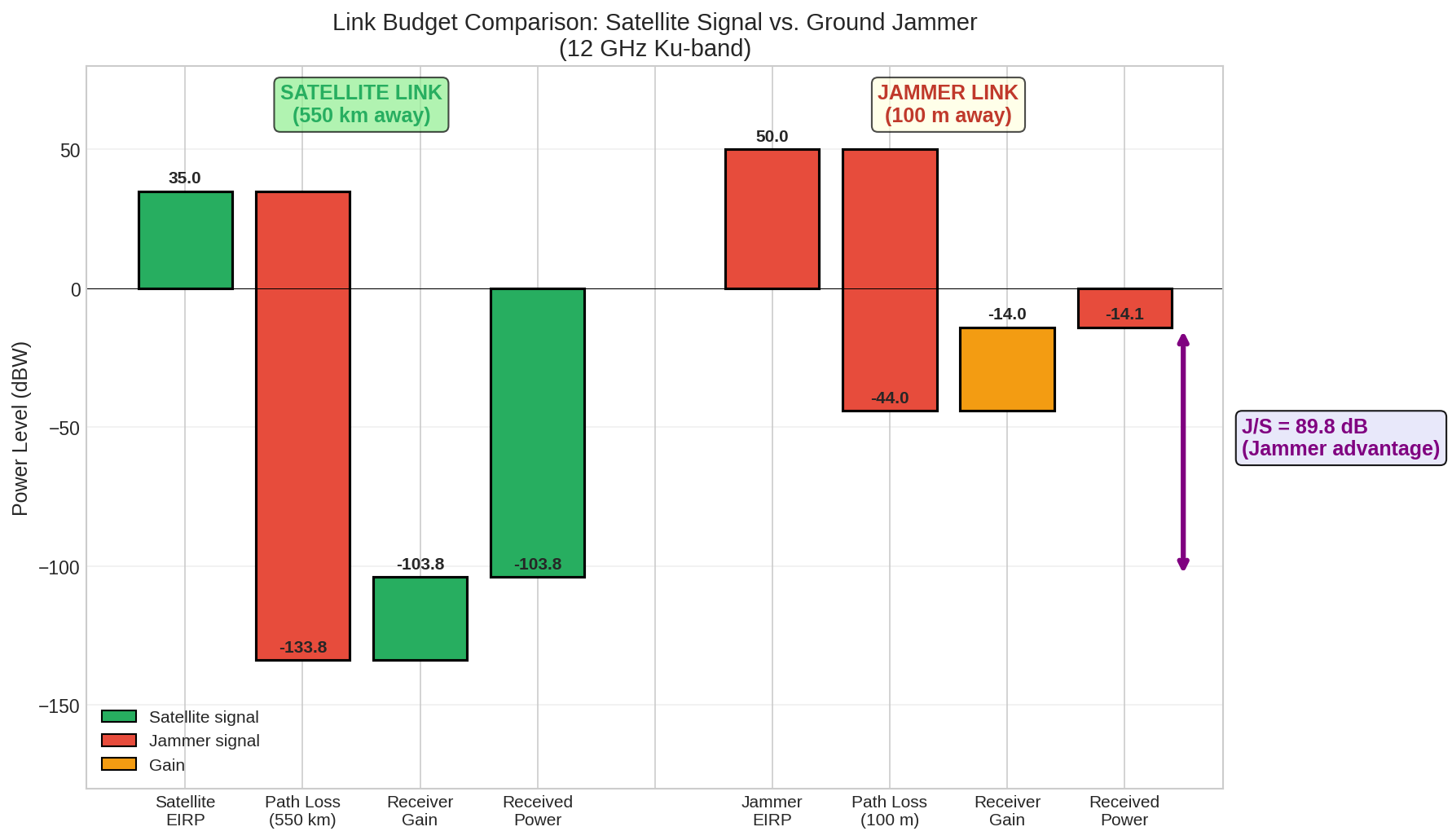
Let’s formalize why Perez’s statement is correct with a concrete link budget analysis.
The Setup
- Satellite altitude: 550 km (Starlink LEO)
- Satellite EIRP: +35 dBW (typical for LEO broadband)
- Jammer distance: 100 meters
- Jammer power: 10 kW (+40 dBW)
- Jammer antenna gain: 10 dBi (modest directional antenna)
- Frequency: 12 GHz (Ku-band downlink)
Free Space Path Loss
The satellite signal experiences free space path loss (FSPL) over 550 km. Using the standard FSPL formula:
FSPL = 20×log₁₀(d) + 20×log₁₀(f) + 20×log₁₀(4π/c)
At 550 km and 12 GHz:
- FSPL (satellite) = 114.8 + 201.6 - 147.55 = 168.85 dB
The jammer at 100 m:
- FSPL (jammer) = 40 + 201.6 - 147.55 = 94.05 dB
Received Power Comparison
Satellite signal at receiver:
P_sat = EIRP - FSPL + G_rx = 35 - 168.85 + 30 = -103.85 dBW
Jammer signal at receiver (assuming jammer antenna pointed at terminal):
P_jam = P_tx + G_tx - FSPL + G_rx = 40 + 10 - 94.05 + 30 = -14.05 dBW
Jamming-to-Signal Ratio
J/S = P_jam - P_sat = -14.05 - (-103.85) = 89.8 dB
The jammer is nearly 90 dB stronger than the satellite signal at the receiver.
Countermeasure Accounting
Now let’s apply our software countermeasures:
| Countermeasure | Typical Gain |
|---|---|
| Null steering | 40 dB |
| Spread spectrum processing | 20 dB |
| FEC coding gain | 10 dB |
| Total | 70 dB |
Even with 70 dB of combined countermeasures, the jammer still wins by:
89.8 - 70 = 19.8 dB
A 20 dB disadvantage means the jammer is 100× stronger than what you can tolerate. The link is dead.
The Distance Dependency
The critical variable is jammer distance. At what range would countermeasures suffice?
If we need J/S ≤ 70 dB for countermeasures to work, and satellite signal is fixed at -103.85 dBW, the jammer signal must be ≤ -33.85 dBW at the receiver.
Working backward with jammer EIRP of +50 dBW:
-33.85 = 50 - FSPL_jam + 30 FSPL_jam = 113.85 dB
At 12 GHz, this corresponds to approximately 5 km distance.
In other words: a 10 kW jammer becomes manageable only when it’s 50× farther away—5 km instead of 100 meters.
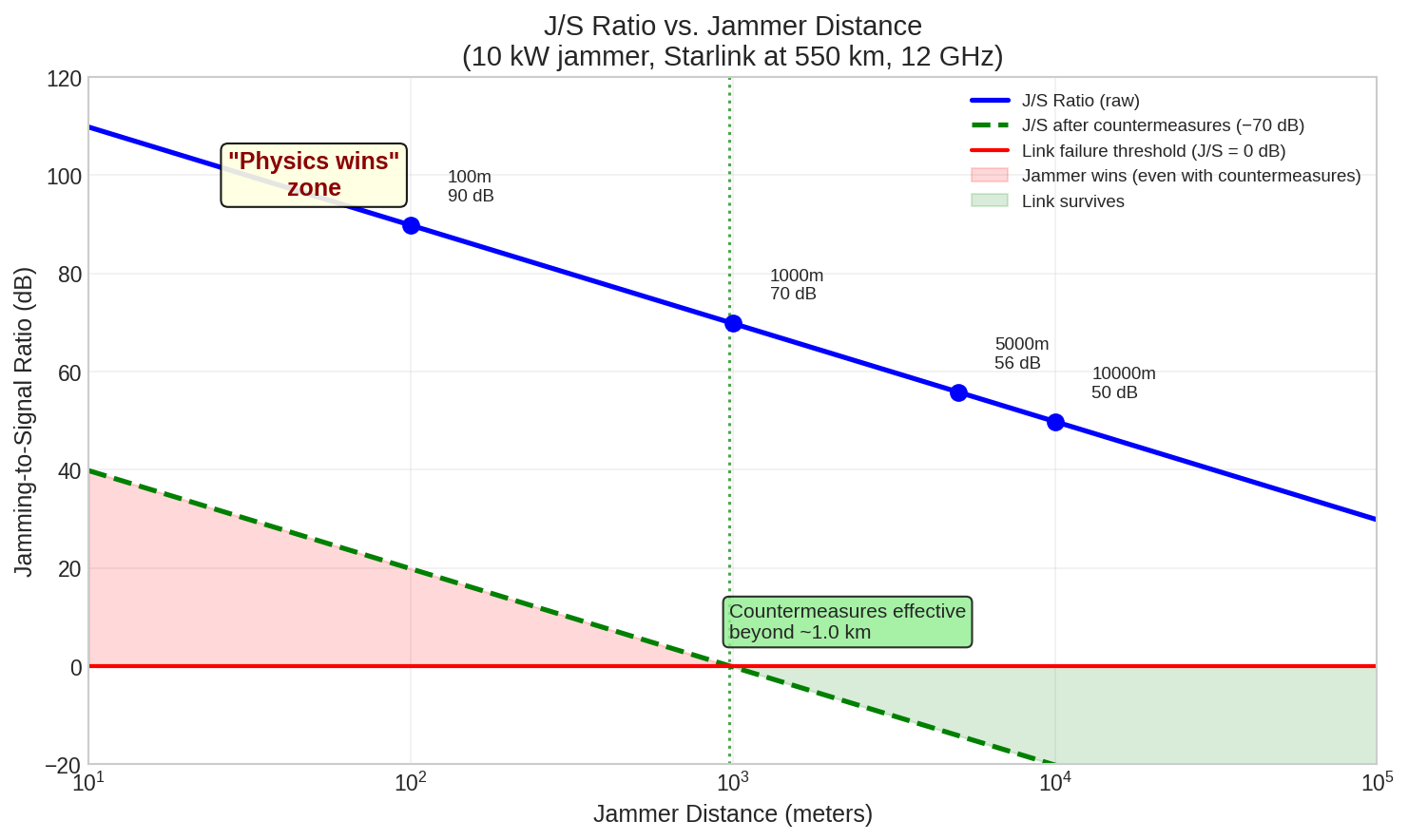
This is the physics Perez references. When the jammer is close, software countermeasures provide marginal improvements against an overwhelming signal strength advantage. The math doesn’t lie.
What Software Countermeasures Can Solve
This analysis shouldn’t imply that adaptive beamforming, spread spectrum, and FEC are useless. They solve different problems:
1. Distant Jammers
Against a jammer at 50+ km, the range advantage shrinks dramatically. A 10 kW jammer at 50 km might produce J/S of only 50 dB—well within countermeasure capability.
2. Lower-Power Interference
Car GPS jammers, which typically output 0.1–1 W, are easily handled by spread spectrum and FEC. The J/S against satellite signals is modest, and processing gain nullifies them.
3. Narrowband Interference
Frequency hopping defeats any jammer that can’t cover the entire spread bandwidth. Even partial-band jamming is manageable—only affecting the fraction of hops that land in the jammed region.
4. Spoofing (Non-Power-Based Attacks)
Software is highly effective against spoofing, where the attacker isn’t trying to overpower signals but rather inject false ones. Signal authentication, Doppler consistency checks, and multi-source verification are all software-domain solutions.
SpaceX’s GPS-free positioning is a perfect example: it didn’t make the terminal more resistant to raw jamming power, but it eliminated an attack vector that required no power advantage at all.
The Only Defense Against Near-Field Jamming: Physical Measures
When software fails, physics demands physical solutions:
1. Faraday Shielding
Surrounding the terminal with RF-absorbent material or metal barriers that block horizontal signals while allowing vertical (skyward) signals creates a physical null.
Reports from Iran described users placing terminals in pits or behind sandbag barriers—improvised Faraday shields that attenuated ground-level jamming while preserving satellite line-of-sight.
2. Location, Location, Location
Moving the terminal farther from the jammer is the most effective countermeasure. Every doubling of distance reduces jammer power by 6 dB.
In Iran, Starlink service remained partially operational in rural and border areas where vehicle-mounted jammers couldn’t maintain continuous coverage.
3. Counter-EW (Kinetic Solutions)
In military contexts, the response to enemy jamming may be targeting the jammer itself—with missiles, drones, or artillery. This is obviously not available to civilian users.
Conclusion: Engineering Within Physical Limits
The Iran jamming campaign demonstrated both the power and the limits of software countermeasures. SpaceX’s rapid software deployment—GPS-free positioning within five days—showcased world-class RF engineering. Service was partially restored. Some communications got through.
But against military-grade, multi-kilowatt, close-proximity jamming, software provides mitigation, not immunity. The fundamental asymmetry—a jammer 100 meters away versus a satellite 550 km away—creates a power differential that no algorithm can fully overcome.
Carlos Perez’s statement wasn’t defeatism. It was engineering realism. Software can buy you 10–70 dB of jamming margin through clever beamforming, spread spectrum, and coding gains. Against a jammer with an 80–90 dB advantage, that margin isn’t enough.
Physics wins.
The implications extend beyond Starlink. Any satellite communication system—GNSS, satcom, satellite IoT—faces the same fundamental vulnerability. Signals arriving from space are inherently weak. Terrestrial jammers are inherently close.
The solution set must include:
- Layered architectures that don’t depend solely on any single RF link
- Alternative PNT sources like LEO-based positioning that offer stronger signals
- Ground infrastructure (optical fiber, mesh networks) as backup
- Physical resilience through geographic distribution and hardened installations
Software countermeasures are essential—but they’re one layer in what must be a multi-domain defense. When the adversary can park a truck with a kilowatt transmitter outside your window, no firmware update is saving you.
The engineers at SpaceX know this. The question is whether policymakers, operators, and users understand the limits of what technology can provide.
TL;DR
- Iran’s January 2026 jamming achieved 80% packet loss against Starlink using military-grade, mobile Ku-band jammers plus GPS spoofing
- SpaceX’s software update (GPS-free positioning) addressed spoofing but had limited effect against direct RF jamming
- Adaptive beamforming can reject jammers by 40+ dB through null steering—but not enough against close, high-power sources
- Frequency hopping provides 10–60 dB processing gain—but wideband jammers covering the entire band negate this advantage
- Forward error correction adds ~10 dB coding gain—insufficient against 80+ dB signal deficits
- Link budget math: A 10 kW jammer at 100 m creates ~90 dB advantage over a Starlink signal. Combined software countermeasures provide ~70 dB rejection. Jammer wins by 20 dB.
- Physical distance is the only effective countermeasure against high-power near-field jamming: at 5+ km, the same jammer becomes manageable
- “Physics wins” isn’t defeatism—it’s engineering realism about the limits of software in RF warfare
Sources
- New York Sun: How Iran Blocked ‘Impenetrable’ Starlink
- GPS World: Anti-Jam Technology - Demystifying the CRPA
- Rohde & Schwarz: Technology Fundamentals of Hopper Signals
- RF Cafe: Jamming-to-Signal Ratio Calculations
- Wikipedia: Free-Space Path Loss
- Wikipedia: Frequency-Hopping Spread Spectrum
- Cyntony: How Much J/S Do You Really Need?
- Medium: Jamming and Unjamming Starlink
- MDPI Sensors: Null-Steering Control Techniques for GNSS Anti-Jamming
- Frontiers in Physics: Anti-Jamming Capabilities of LEO Systems
Join the discussion
Thoughts, critiques, and curiosities are all welcome.