AI
A Re-visit of the Concept of AI Agent in 2026
From AutoGPT's Wright Flyer moment to Claude Skills and MCP—understanding the paradigm shifts that turned AI agents from demos into infrastructure.
I’ve been using AI agents daily for over a year now. Claude Code writes most of my boilerplate. Custom skills handle my document workflows. MCP servers connect everything to my actual tools. What once felt like science fiction is now just… how I work.
But step back and the landscape is genuinely confusing. AutoGPT, Devin, Claude Code, Cursor, OpenClaw, MCP, Skills, Hooks—these terms get thrown around interchangeably when they represent fundamentally different things.
This article is my attempt to make sense of it all. Not just what happened, but why it matters and how the pieces fit together.
The Core Insight: AI Went From “Brain in a Box” to “Brain With Hands”
The simplest way to understand the AI agent revolution is this:
2022-2023: LLMs were incredibly smart but trapped. They could reason, write, and analyze—but couldn’t do anything. Ask ChatGPT to “send an email” and it would write the email, then politely explain it couldn’t actually send it.
2024-2026: LLMs got hands. They can now execute code, call APIs, browse the web, manage files, and orchestrate other agents. The constraint isn’t intelligence anymore—it’s what tools you give them access to.
This shift from “assistant that suggests” to “agent that acts” is the story of the last three years.
The Timeline: Four Paradigm Shifts
Rather than a comprehensive history, let me highlight the moments where the paradigm actually changed.

Shift 1: The Loop (March 2023)
AutoGPT proved that LLMs could run in loops—setting goals, breaking them into tasks, executing, evaluating results, and iterating. It was the Wright Flyer of AI agents: barely functional, wildly exciting.
Goal → Plan → Execute → Evaluate → RepeatAutoGPT hit 100,000 GitHub stars faster than any project in history. It also got stuck in infinite loops, hallucinated constantly, and burned through API credits. But it showed the path.
What changed: We stopped thinking of LLMs as one-shot generators and started thinking of them as reasoning engines that could drive multi-step processes.
Shift 2: Professional Tools (2024)
Devin (March 2024) and Cursor Composer (September 2024) proved agents could work in professional contexts.
Devin wasn’t just an agent—it had its own shell, code editor, and web browser. It could clone repos, run tests, debug failures, and submit pull requests. On SWE-Bench, it resolved 13.86% of real GitHub issues end-to-end (previous state-of-the-art: 1.96%).
Cursor Composer integrated this capability into a real IDE. Developers reported 90% of their code being AI-generated—not autocomplete, but multi-file implementations from natural language descriptions.
What changed: Agents moved from experiments to tools that professionals actually used. The question shifted from “can agents work?” to “how do we integrate them into real workflows?”
Shift 3: The Protocol Layer (Late 2024 - 2025)
This is where things get interesting—and where most coverage misses the point.
November 2024: Anthropic open-sourced the Model Context Protocol (MCP)—a standard for how AI agents connect to external tools and data sources.
Most people ignored it. Another protocol, another standard that would die in committee.
Twelve months later: MCP has 8 million+ server downloads, 5,800+ available servers, and adoption from OpenAI, Google, Microsoft, Block, Bloomberg, and hundreds of Fortune 500 companies. In December 2025, Anthropic donated MCP to the Agentic AI Foundation under the Linux Foundation.
Why this matters more than any individual tool:
Before MCP, every agent needed custom integrations. Want Claude to access your database? Write a custom integration. Want it to use Slack? Another integration. GitHub? Another one. This meant:
- Massive engineering overhead for every new capability
- Vendor lock-in (your Cursor integrations didn’t work with Claude Code)
- Security nightmares (every integration was a bespoke attack surface)
MCP created a universal adapter layer. Build an MCP server once, and any MCP-compatible agent can use it. The ecosystem now has servers for everything—databases, APIs, file systems, browsers, and specialized tools.
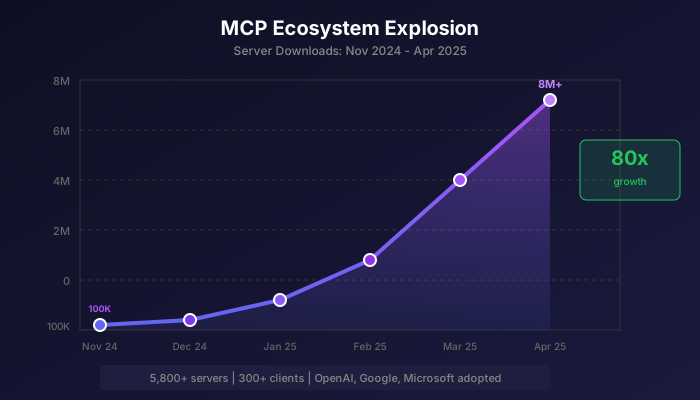
What changed: Agent capabilities became composable and portable. Instead of building agents, you now assemble them from standardized components.
Shift 4: Extensible Intelligence (October 2025 - Present)
This is the shift most people haven’t fully absorbed yet: Claude Skills and Hooks.
October 16, 2025: Anthropic released Agent Skills—a complete system for extending Claude with modular capability packages.
Skills aren’t just prompts. They’re folders containing instructions, scripts, and resources that Claude loads dynamically. The architecture is sophisticated:
- Level 1 (Metadata): Skill names and descriptions pre-loaded in system prompt
- Level 2 (Core Instructions): Full skill content loads only when Claude determines it’s relevant
- Level 3+ (Nested Resources): Additional files load on-demand
This means context is effectively unbounded. Claude can have access to hundreds of specialized capabilities without consuming context window on irrelevant ones.
The killer feature: Skills can include executable code. Python scripts, Bash commands, deterministic operations that run with full reliability. Claude reasons about when to use them, but the execution is code, not token generation.
Hooks complement this by providing guaranteed automation at lifecycle events:
SessionStart: Load project context, set environment variablesPreToolUse: Validate or block dangerous commands before executionPostToolUse: Auto-format code, run tests after changesStop: Push to staging, generate summaries when Claude finishes
The difference from prompts is critical: hooks are guaranteed to execute. They’re shell commands or HTTP calls, not suggestions Claude might follow.
What changed: Agents became programmable platforms, not just chat interfaces. You can now build workflows where AI reasoning and deterministic code interleave seamlessly.
The Current Landscape (March 2026)
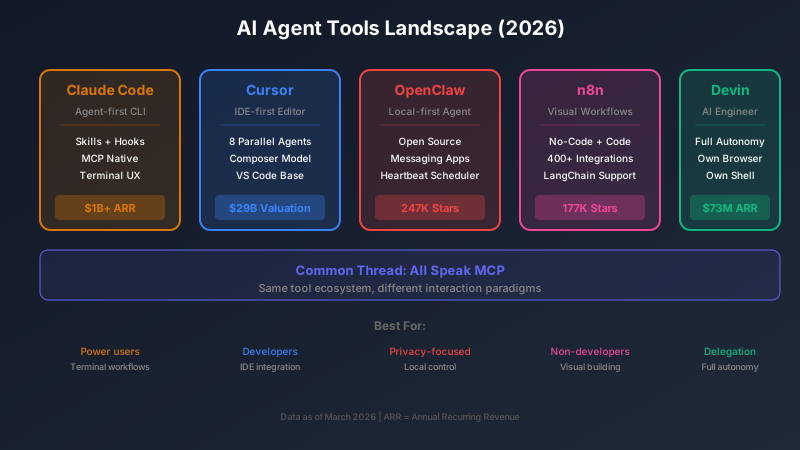
Here’s how the major players fit together:
| Tool | Philosophy | Strength | Best For |
|---|---|---|---|
| Claude Code | Agent-first CLI | Skills, Hooks, MCP ecosystem | Power users who want programmable agents |
| Cursor | IDE-first, multi-agent | 8 parallel agents, Composer model | Developers who live in their editor |
| OpenClaw | Local-first, open-source | Runs on your device, messaging integration | Privacy-conscious users, tinkerers |
| n8n | Visual workflow builder | No-code + code hybrid, 400+ integrations | Non-developers, workflow automation |
| Devin | Autonomous engineer | Full environment control | Delegating complete engineering tasks |
The common thread: They all speak MCP. They can all connect to the same tool ecosystem. The differentiation is in how you interact with agents, not what they can access.
5 Use Cases That Actually Work (From Experience)
Skip the hype. Here’s what agents reliably handle in production:
1. Codebase-Wide Refactoring
This is where agent coding shines brightest. Not writing new features—refactoring existing ones.
Example: Rename a function used across 47 files, update all call sites, fix the tests that break, and ensure the build passes. With Claude Code, I describe what I want, it explores the codebase, makes the changes, runs tests, iterates on failures, and presents the result.
Time investment: 5 minutes of description, 20 minutes of agent work, 10 minutes of review. Previous time: 2-3 hours of careful manual edits.
2. Document Processing Pipelines
Claude Skills for Excel, PowerPoint, Word, and PDF aren’t gimmicks—they’re genuinely useful.
Example: Extract data from 50 invoices (PDFs, some scanned), reconcile against a spreadsheet, flag discrepancies, generate a summary report. The document skills handle parsing; Claude handles reasoning about discrepancies.
3. Automated Code Review
Not replacing human review—augmenting it.
PostToolUse hooks run linters and security scanners after every change. Skills encode your team’s style guide and architecture patterns. By the time I look at Claude’s output, the obvious issues are already fixed.
4. Research and Synthesis
Give an agent access to web search, documentation, and your notes. Ask it to research a topic and synthesize findings.
Example: “Research the current state of WebAssembly for serverless functions. Focus on cold start times, language support, and production deployments. Synthesize into a decision document.”
The agent searches, reads documentation, finds case studies, and produces a structured analysis. Not perfect—but a solid first draft that would have taken me hours to assemble.
5. Multi-System Coordination
MCP servers for Slack, GitHub, calendar, and project management. One prompt triggers a workflow across systems.
Example: “Create a GitHub issue for the authentication bug we discussed, add it to the sprint board, schedule a 30-minute review with the security team, and post a summary to the #security channel.”
What Doesn’t Work (Yet)
Honesty requires acknowledging the limits:
Novel architecture decisions: Agents are great at implementing patterns they’ve seen. They struggle with genuinely novel design choices where the right answer isn’t in their training data.
Subtle bugs: Agents catch obvious errors but miss subtle logic issues, race conditions, and edge cases that require deep domain understanding.
Long-running reliability: Multi-hour autonomous tasks still drift. Agents work best with human checkpoints.
Security-critical code: I don’t let agents write authentication, encryption, or payment processing without line-by-line review.
Making Sense of It All
If you’re trying to understand where to start, here’s my mental model:
Layer 1: The Protocol (MCP) The foundation. Enables agents to connect to tools. You don’t interact with this directly, but it’s why everything works together.
Layer 2: The Runtimes (Claude Code, Cursor, OpenClaw) Where you actually use agents. Choose based on your workflow preference—terminal, IDE, or messaging apps.
Layer 3: The Extensions (Skills, Hooks, MCP Servers) How you customize agents for your specific needs. This is where the real power emerges.
Layer 4: The Orchestration Multi-agent systems where specialized agents coordinate. Still early, but this is where enterprise is heading.
The Honest Assessment
AI agents in 2026 are real and useful. I’m genuinely more productive than I was two years ago.
But the hype often outpaces reality. Agents don’t replace thinking—they amplify it. They’re incredible at executing well-defined tasks and terrible at figuring out what tasks to execute.
The developers thriving with agents are the ones who understand this distinction. They use agents for the tedious 80% and focus their own attention on the strategic 20%.
The technology will keep improving. The question is whether you’re learning to work with it now, while the patterns are still being established, or waiting until the approaches calcify.
TL;DR
- The core shift: LLMs went from “brain in a box” to “brain with hands”
- Four paradigm shifts: Loops (AutoGPT) → Professional tools (Devin/Cursor) → Protocol layer (MCP) → Extensible intelligence (Skills/Hooks)
- MCP is the real story: 8M+ downloads, 5,800+ servers, adopted by everyone. Universal adapter for agent capabilities.
- Claude Skills/Hooks: Turn agents into programmable platforms with dynamic context and guaranteed automation
- What works: Refactoring, document processing, code review augmentation, research synthesis, multi-system coordination
- What doesn’t: Novel architecture, subtle bugs, long-running autonomy, security-critical code
Sources
- AutoGPT - Wikipedia
- Cognition - Introducing Devin
- Anysphere / Cursor History - Taskade
- A Year of MCP - Pento
- Model Context Protocol - Wikipedia
- Introducing Agent Skills - Anthropic
- Claude Code Hooks - DataCamp
- Hooks Reference - Claude Code Docs
- OpenClaw - The Complete 2026 Guide
- Agentic AI Strategy - Deloitte
- 2026: Enterprise-Ready MCP Adoption - CData
Join the discussion
Thoughts, critiques, and curiosities are all welcome.