Space Tech
From Meters to Millimeters: The Evolution of GNSS Positioning Solutions
A comprehensive guide to GNSS solution types—SPP, DGNSS, RTK, PPP, and beyond—and how to choose the right one for your application.
When GPS first became available to civilians in the 1980s, getting within 100 meters of your actual position felt like magic. Today, surveyors routinely achieve centimeter-level accuracy, and autonomous vehicles demand even better. This dramatic improvement didn’t happen overnight—it’s the result of decades of innovation in how we process satellite signals.
If you’ve ever wondered why your drone needs RTK, why your survey crew talks about “fixing ambiguities,” or why that precision agriculture system costs so much more than a handheld GPS, this guide is for you. We’ll trace the evolution from basic GPS to cutting-edge PPP-RTK, explain what each solution type actually does, and help you pick the right tool for your job.
The Accuracy Spectrum: A Bird’s-Eye View
Before diving into the technical details, here’s the landscape at a glance:
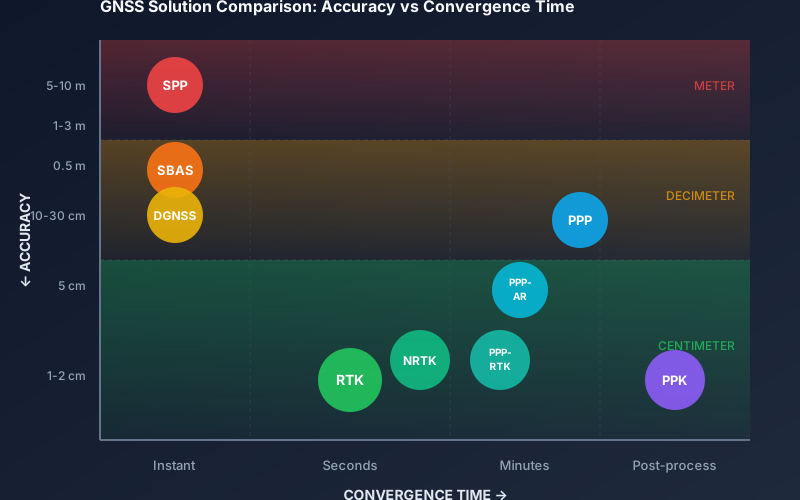
The pattern is clear:
- Meter-level (SPP, SBAS, DGNSS) — Instant, minimal infrastructure
- Decimeter-level (PPP) — Global coverage, but requires patience (15-30 min)
- Centimeter-level (RTK, NRTK, PPP-RTK, PPK) — Requires base stations, networks, or post-processing
Quick Reference
| Solution | Accuracy | Time | Range |
|---|---|---|---|
| SPP | 5-10 m | ⚡ | Global |
| SBAS | 1-3 m | ⚡ | Regional |
| DGNSS | 0.5-2 m | ⚡ | 50 km |
| PPP | 10-30 cm | 🕐 | Global |
| PPP-AR | <5 cm | 🕐 | Global |
| RTK | 1-2 cm | ⚡ | 20 km |
| NRTK | 2-3 cm | ⚡ | Network |
| PPP-RTK | 2-3 cm | ⚡ | Regional |
| PPK | 1-2 cm | 📊 | 50 km |
⚡ = Instant/Seconds 🕐 = Minutes 📊 = Post-process
The trade-off: more accuracy requires more infrastructure, more complexity, or more patience. Let’s understand why.
The Foundation: How GNSS Positioning Works
Every GNSS solution—from your phone’s GPS to a survey-grade receiver—relies on the same fundamental principle: trilateration. Satellites broadcast their position and the exact time. Your receiver measures how long those signals take to arrive, calculates the distance to each satellite, and solves for your position.
The problem? Those signals travel through 23,000 km of atmosphere, bounce off buildings, and rely on clocks that drift. The errors accumulate:
- Satellite orbit and clock errors: ~2–5 m
- Ionospheric delay: ~5–15 m (varies with solar activity)
- Tropospheric delay: ~2–3 m
- Multipath: 0.5–several meters
- Receiver noise: ~0.5 m
Total potential error: 10+ meters. Every positioning technique we’ll discuss is essentially a different strategy for eliminating or estimating these errors.
SPP: Where It All Begins
Single Point Positioning (SPP) is what your smartphone does. One receiver, broadcast ephemeris, standard atmospheric models. It’s the baseline.
How It Works
SPP uses pseudorange measurements—the code-based distance from your receiver to each visible satellite. The receiver applies standard models to estimate atmospheric delays and uses the broadcast ephemeris (the satellites’ self-reported positions) for orbit information.
What You Get
- Accuracy: 5–10 m horizontal, worse vertical
- Convergence: Instantaneous
- Coverage: Anywhere with satellite visibility
- Cost: The receiver itself
When to Use It
SPP is perfectly adequate for:
- Turn-by-turn navigation
- Fleet tracking (general logistics)
- Recreational outdoor activities
- Any application where “nearby” is good enough
The Limitation
SPP treats all errors with generic models. It doesn’t know if today’s ionosphere is particularly disturbed or if your local troposphere is wetter than average. To do better, we need external information about the errors.
SBAS: Free Accuracy Upgrade
Satellite-Based Augmentation Systems were developed for aviation safety but benefit everyone. WAAS (North America), EGNOS (Europe), MSAS (Japan), and GAGAN (India) provide continental-scale corrections broadcast from geostationary satellites.
How It Works
A network of precisely-surveyed ground stations monitors GPS signals across a region. They calculate corrections for satellite orbit/clock errors and create a grid-based ionospheric model. These corrections are uplinked to geostationary satellites and broadcast on GPS frequencies—your receiver picks them up automatically.
What You Get
- Accuracy: 1–3 m horizontal
- Convergence: Instantaneous
- Coverage: Within SBAS service area
- Cost: SBAS-capable receiver (standard in most modern GNSS chips)
When to Use It
SBAS shines for:
- Aviation approach procedures
- Maritime navigation
- GIS data collection (meter-level)
- Agriculture guidance (non-precision)
The Limitation
SBAS corrections are regional averages. They improve on SPP significantly, but can’t capture local atmospheric variations or provide the centimeter-level accuracy that precision applications demand.
DGNSS: The Power of Nearby Reference
Differential GNSS introduces a simple but powerful concept: if you have a receiver at a known location, you can measure the errors directly and tell nearby receivers how to correct for them.
How It Works
A base station at a precisely-surveyed point continuously computes the difference between its known position and its GPS-derived position. This difference—the pseudorange correction—is broadcast to rovers in the area. Since atmospheric errors are spatially correlated, nearby receivers experience similar errors and benefit from the correction.
What You Get
- Accuracy: 0.5–2 m
- Convergence: Instantaneous
- Coverage: Typically 50–100 km from base (accuracy degrades with distance)
- Cost: Base station + data link + rover
When to Use It
DGNSS is ideal for:
- Marine navigation
- Dredging operations
- Construction site monitoring
- Any application needing sub-meter accuracy without carrier-phase complexity
The Limitation
DGNSS uses code measurements only. The pseudorange measurement has inherent noise of ~0.5–1 m, which sets a floor on achievable accuracy. To break through to centimeter-level, we need to exploit the carrier phase.
RTK: The Centimeter Revolution
Real-Time Kinematics transformed surveying, construction, and precision agriculture by achieving centimeter accuracy in real time. It’s the workhorse of high-precision GNSS.
How It Works
RTK uses carrier phase measurements—not just the code, but the actual wave cycles of the satellite signal. The carrier wavelength is ~19 cm (L1), allowing much finer distance measurement than code (~300 m chip length for C/A code).
The challenge: your receiver can measure the fractional phase precisely, but doesn’t know how many complete wavelengths are between you and the satellite. This is the integer ambiguity problem.
RTK solves this through double-differencing:
- Difference between two satellites (eliminates receiver clock error)
- Difference between base and rover (eliminates satellite clock error)
- Short baseline means similar atmospheric errors, which largely cancel
With errors eliminated through differencing, the receiver can solve for the integer ambiguities and achieve centimeter-level positioning.
What You Get
- Accuracy: 1–2 cm horizontal, 2–4 cm vertical
- Convergence: Seconds to tens of seconds (once ambiguities are “fixed”)
- Coverage: ~15–20 km from base for single-frequency, up to ~70 km for dual-frequency
- Cost: Base station + rover + real-time data link
When to Use It
RTK is the standard for:
- Land surveying
- Construction machine control
- Precision agriculture (autosteer, variable rate)
- Drone mapping (real-time georeferencing)
- Any application requiring centimeter accuracy in real time
The Limitations
- Baseline length: Atmospheric errors decorrelate with distance; accuracy degrades beyond 20 km
- Infrastructure: Need a base station or CORS network
- Data link: Requires reliable real-time communication
- Initialization: Need to solve ambiguities each time; can lose “fix” under trees or bridges
NRTK: Network Power
Network RTK extends RTK’s capabilities by using multiple reference stations to model atmospheric errors across a region.
How It Works
Instead of a single base, NRTK uses a network of Continuously Operating Reference Stations (CORS). The network software:
- Collects data from all reference stations
- Models spatial variations in atmospheric errors
- Generates a “virtual reference station” (VRS) or area corrections tailored to the rover’s location
- Streams corrections to the rover via cellular/internet (NTRIP protocol)
What You Get
- Accuracy: 2–3 cm
- Convergence: Seconds
- Coverage: Entire network footprint (can be state/country-wide)
- Cost: Subscription fee + dual-frequency rover
When to Use It
NRTK has become the default for:
- Professional surveying (no more hauling base stations)
- Large construction projects
- Precision agriculture over large areas
- Fleet positioning where centimeter accuracy matters
The Consideration
You’re dependent on cellular coverage and a subscription service. In 2026, NRTK via NTRIP is mature and reliable in most developed regions, but remote areas may lack coverage.
PPP: Global Precision Without a Base
Precise Point Positioning takes a fundamentally different approach. Instead of differencing with a nearby base, PPP uses globally-valid corrections to eliminate satellite errors and estimates atmospheric delays directly.
How It Works
PPP requires:
- Precise satellite orbits and clocks: From services like IGS, these are orders of magnitude better than broadcast ephemeris
- Dual-frequency observations: To estimate ionospheric delay
- Tropospheric modeling + estimation: Combination of models and state estimation
- Carrier phase processing: For centimeter-level precision
The receiver runs a filter (typically Kalman) that simultaneously estimates position, receiver clock, tropospheric delay, and carrier phase ambiguities. These parameters are highly correlated, so the filter needs time to converge to accurate estimates.
What You Get (Float Solution)
- Accuracy: 10–30 cm
- Convergence: 15–30 minutes
- Coverage: Global (anywhere with correction stream)
- Cost: Dual-frequency receiver + correction service
The Convergence Problem
PPP’s Achilles heel is convergence time. Unlike RTK, where differencing eliminates most errors immediately, PPP must observe enough satellite geometry change to decorrelate its state estimates. This takes tens of minutes—too slow for many applications.
PPP-AR: Resolving Ambiguities for Better Accuracy
PPP with Ambiguity Resolution enhances standard PPP by treating carrier phase ambiguities as integers (their true nature) rather than floats.
How It Works
The challenge with PPP ambiguity resolution is that satellite and receiver phase biases contaminate the measurements, destroying their integer nature. PPP-AR services provide additional phase bias corrections that restore integer characteristics.
With ambiguities fixed to integers, the filter has fewer unknowns and converges faster to higher accuracy.
What You Get
- Accuracy: < 5 cm (often 2–3 cm)
- Convergence: 3–15 minutes (still not instant)
- Coverage: Global
- Cost: PPP-AR correction service subscription
Commercial Services
Services like Trimble CenterPoint RTX, Hexagon TerraStar, and u-blox PointPerfect provide PPP-AR corrections. Some are broadcast via satellite (L-band), others via internet.
PPP-RTK: Best of Both Worlds
PPP-RTK combines PPP’s state-space approach with regional atmospheric modeling to achieve RTK-like convergence times without individual base stations.
How It Works
PPP-RTK services provide State Space Representation (SSR) corrections including:
- Precise orbits and clocks (like standard PPP)
- Phase biases for ambiguity resolution
- Regional ionospheric corrections (the key differentiator)
- Regional tropospheric corrections
With atmospheric delays directly corrected rather than estimated, ambiguities can be resolved almost immediately.
What You Get
- Accuracy: 2–3 cm
- Convergence: < 1 minute (often < 15 seconds in good conditions)
- Coverage: Regional (within atmospheric correction network)
- Cost: PPP-RTK service subscription
Why It Matters
PPP-RTK represents the direction the industry is heading. It combines:
- RTK-like accuracy and convergence
- No base station dependency
- Scalable correction distribution (one stream serves unlimited users)
- Better performance in challenging environments (can re-acquire fix faster)
PPK: When Real-Time Doesn’t Matter
Post-Processed Kinematics applies the same principles as RTK, but processes data after collection rather than in the field.
How It Works
Both base and rover log raw observations during the survey. Later, software processes them together, with the advantage of:
- Forward-backward filtering: Process time-forward and time-backward, then combine for optimal estimates
- No real-time data link required: Critical in remote areas
- Longer baselines: Can leverage reference stations further away
- Recovery from cycle slips: Can often resolve issues that would break real-time processing
What You Get
- Accuracy: 1–2 cm (sometimes better than real-time RTK)
- Convergence: N/A (post-processing)
- Coverage: Anywhere with GNSS + later access to reference data
- Cost: Raw-logging receiver + post-processing software
When to Use It
PPK is preferred for:
- Drone/UAV mapping (especially when flying beyond data link range)
- Remote area surveys
- Any mission-critical work where you want the best possible accuracy
- As a backup when RTK fails in the field
Long-Baseline RTK: Pushing the Limits
Long-baseline RTK attempts centimeter accuracy at distances of 50–100+ km from a single base station.
How It Works
At longer baselines, atmospheric errors no longer cancel through differencing. Long-baseline RTK must:
- Use dual-frequency observations to eliminate first-order ionospheric effects
- Estimate residual atmospheric delays as additional unknowns
- Accept longer convergence times and potentially reduced reliability
What You Get
- Accuracy: Centimeter to decimeter (distance-dependent)
- Convergence: Minutes
- Coverage: Extended range from base
- Reliability: Lower than short-baseline RTK
The Trade-off
Long-baseline RTK occupies an awkward middle ground. It’s more complex than standard RTK but less global than PPP. In practice, NRTK or PPP-RTK often prove more practical for extended coverage.
Choosing the Right Solution
Decision Framework
Step 1: What accuracy do you actually need?
| Application | Typical Requirement |
|---|---|
| General navigation | 5–10 m (SPP is fine) |
| GIS asset collection | 1–3 m (SBAS or DGNSS) |
| Agriculture guidance | 10–30 cm (PPP) or 2–3 cm (RTK) |
| Drone mapping | 2–5 cm (RTK or PPK) |
| Surveying/stakeout | 1–2 cm (RTK or NRTK) |
| Machine control | 1–2 cm (RTK or NRTK) |
Step 2: Real-time or post-process?
- Need instant positions in the field? → RTK, NRTK, or PPP-RTK
- Can process later? → PPK often delivers better results with less field complexity
Step 3: What infrastructure is available?
- Own base station? → RTK or PPK
- CORS network in your area? → NRTK
- No local infrastructure? → PPP or PPP-RTK (with correction service)
Step 4: What’s your connectivity situation?
- Reliable cellular? → NRTK or PPP-RTK via NTRIP
- Spotty connectivity? → PPK as backup
- No connectivity? → L-band PPP services or PPK
The Future: Where GNSS Positioning Is Heading
Multi-Constellation, Multi-Frequency
Modern receivers track GPS, GLONASS, Galileo, and BeiDou simultaneously across multiple frequencies. More satellites mean better geometry; multiple frequencies enable direct ionospheric measurement. This benefits all solution types.
Instant PPP
With modernized constellations (GPS III, Galileo HAS), convergence times for PPP are dropping. Some services now claim sub-5-minute convergence for centimeter accuracy. The gap between PPP and RTK is closing.
Authentication
Galileo’s OSNMA and upcoming GPS CHIMERA provide signal authentication, helping receivers detect spoofing. As GNSS becomes critical infrastructure for autonomous systems, authentication moves from “nice to have” to essential.
LEO Augmentation
Low Earth Orbit satellites (Starlink, Xona, others) promise additional ranging signals with better geometry and stronger power. LEO-PNT won’t replace GNSS but adds resilience and could accelerate convergence for PPP-type solutions.
TL;DR
- SPP (5–10 m): Your phone. No corrections. Works everywhere.
- SBAS (1–3 m): Free regional corrections. Good enough for many applications.
- DGNSS (0.5–2 m): Code-based corrections from a nearby base. Maritime standard.
- RTK (1–2 cm): Carrier-phase magic with a local base. The surveyor’s workhorse.
- NRTK (2–3 cm): RTK without hauling your own base. Requires subscription.
- PPP (10–30 cm): Global corrections, no base needed, but slow convergence.
- PPP-AR (< 5 cm): PPP with ambiguity resolution. Better accuracy, still slow.
- PPP-RTK (2–3 cm): The future. Fast convergence, no base, regional coverage.
- PPK (1–2 cm): Process later for best accuracy. Essential for drones.
The right choice depends on your accuracy needs, real-time requirements, available infrastructure, and budget. For most professional applications in 2026, NRTK or PPP-RTK offers the best balance of accuracy, convenience, and coverage.
Sources
- GNSS Positioning Techniques - World of GNSS
- RTK, PPP and Autonomous Positioning - GNSS.store
- Differences between RTK and PPP - Tersus GNSS
- Network RTK vs PPP-RTK Performance - u-blox
- GNSS Augmentation - Navipedia (ESA)
- Which Correction Method? - NovAtel
- Precise Point Positioning - Wikipedia
- PPP-RTK with Rapid Convergence - MDPI Remote Sensing
Join the discussion
Thoughts, critiques, and curiosities are all welcome.