Lesson Learned
ODM, PCBA, and EMS: The Building Blocks of Electronics Manufacturing
A clear guide to understanding Original Design Manufacturing, Printed Circuit Board Assembly, and Electronics Manufacturing Services — and how they fit together.
Ever wonder how a smartphone goes from an idea to the device in your hand? Behind every electronic product is a web of manufacturing models and processes that most people never think about. Three acronyms dominate this world: ODM, PCBA, and EMS.
They sound similar, get used interchangeably, and can be genuinely confusing. But understanding the differences is key to grasping how modern electronics actually get made — whether you’re a curious tech enthusiast, a startup founder, or someone exploring the hardware industry.
Let’s Start With the Basics
Before diving into each term, here’s the most important distinction to keep in mind:
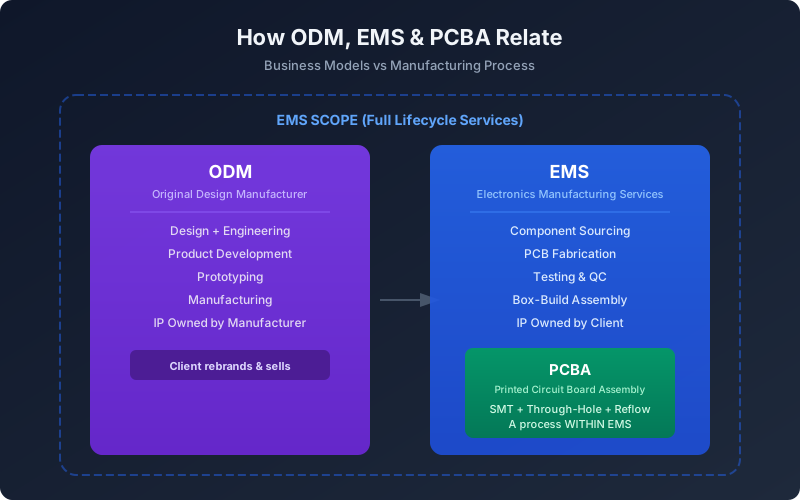
- ODM and EMS are business models — they describe the relationship between a brand and a manufacturer.
- PCBA is a manufacturing process — it describes a specific step in making electronics.
Think of it this way: ODM and EMS describe who does what, while PCBA describes how something gets built.
What Is PCBA?
PCBA stands for Printed Circuit Board Assembly. It’s the process of taking a bare printed circuit board (PCB) — that green (or blue, or black) board you see inside any electronic device — and populating it with electronic components like resistors, capacitors, chips, and connectors.
A bare PCB on its own doesn’t do anything. It’s just a board with copper traces and pads. PCBA is what turns it into a functioning circuit.
How the PCBA Process Works
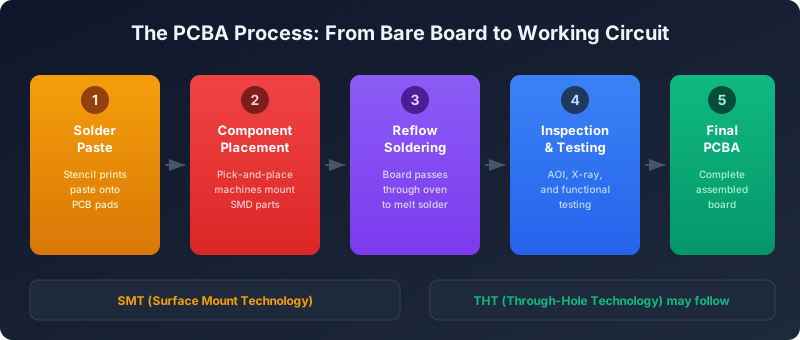
The process typically follows these steps:
-
Solder Paste Application — A stencil is placed over the PCB, and solder paste (a mix of tiny metal balls — 96.5% tin, 3% silver, 0.5% copper) is applied to the pads where components will sit.
-
Component Placement — High-speed pick-and-place machines position tiny surface-mount components onto the board with incredible precision. Modern machines can place tens of thousands of components per hour.
-
Reflow Soldering — The board passes through a reflow oven where temperatures reach around 250°C, melting the solder paste and creating permanent electrical connections.
-
Inspection & Testing — Automated Optical Inspection (AOI) and X-ray machines check for defects like misaligned parts or solder bridges. Functional testing verifies the board actually works.
-
Through-Hole Assembly — Larger components with wire leads (like big capacitors or connectors) are inserted through holes in the board and soldered on the other side, either by wave soldering or by hand.
The key takeaway: PCBA is a process, not a business. It’s one step — arguably the most critical step — in the larger journey of manufacturing an electronic product.
What Is EMS?
EMS stands for Electronics Manufacturing Services. An EMS provider is essentially a one-stop shop for turning someone else’s electronic product design into a finished, shippable product.
Here’s the crucial difference from PCBA: while PCBA is just the board-level assembly, EMS covers the entire manufacturing lifecycle. That includes:
- Component sourcing — Finding and purchasing all the parts
- PCB fabrication — Manufacturing the bare boards themselves
- PCBA — Assembling components onto those boards (yes, PCBA is a subset of EMS)
- Testing & quality control — Ensuring everything works to spec
- Box-build assembly — Putting the finished boards into enclosures with cables, displays, buttons, etc.
- Logistics & distribution — Getting the product to where it needs to go
- After-sales support — Repairs, returns, and maintenance
The key principle: with EMS, the client owns the design and IP. The EMS provider is the expert manufacturer that executes the client’s vision. You bring the blueprint; they build it at scale.
Who Uses EMS?
Companies that have their own R&D teams and product designs, but need manufacturing muscle. Think of a medical device startup that designed a breakthrough patient monitor — they know what to build, but they need a partner who has the factories, supply chains, and quality certifications to build it reliably at volume.
Major EMS Companies
The EMS industry is dominated by some massive players:
- Foxconn (Taiwan) — The world’s largest, manufacturing for Apple, Sony, Nintendo
- Flex Ltd. (USA) — Operations in 30+ countries, ~$25B revenue
- Pegatron (Taiwan) — ~$40B revenue, serves Apple and Microsoft
- Celestica (Canada) — Operations across 15 countries
- Jabil (USA) — Serves automotive, healthcare, and consumer electronics
What Is ODM?
ODM stands for Original Design Manufacturer. This is where it gets interesting — and where most people get confused.
An ODM doesn’t just manufacture your product. They design it too. The ODM creates a product from scratch — the hardware design, the engineering, the prototyping — and then sells it to brands who rebrand it as their own.
You’ve encountered ODM products everywhere, even if you didn’t know it. Search for “car chargers” on Amazon and you’ll see dozens of brands selling what’s essentially the same product with different logos. That’s ODM at work — one manufacturer designed it, and multiple brands licensed and rebranded it.
How ODM Differs from EMS
The fundamental difference comes down to who owns the design:
| EMS | ODM | |
|---|---|---|
| Design | Client designs the product | Manufacturer designs the product |
| IP Ownership | Client owns all IP | Manufacturer retains core IP |
| Customization | Fully custom to client’s spec | Limited (branding, colors, minor tweaks) |
| Client’s Role | Provide design, approve quality | Choose product, apply branding |
| Time to Market | Longer (design must be finalized first) | Faster (product already exists) |
| Cost | Higher (custom engineering) | Lower (shared R&D across clients) |
When Does ODM Make Sense?
ODM is ideal when:
- You want to launch a product fast without investing in R&D
- You don’t need a unique, differentiated hardware design
- You’re testing a market before committing to custom development
- Budget is tight — you skip the expensive design phase entirely
The tradeoff is clear: speed and cost savings vs. uniqueness and IP control.
How They All Connect
Here’s the relationship that ties everything together:
- PCBA is a manufacturing process — it exists inside both EMS and ODM operations
- EMS is a service model where the client owns the design, and the manufacturer handles everything from sourcing to shipping
- ODM is a service model where the manufacturer owns the design, and the client essentially buys and rebrands a finished product
Think of it as nested layers:
PCBA is one step inside EMS, which is one approach alongside ODM. Both EMS and ODM providers perform PCBA — it’s a core part of making any electronic product. The difference is everything that happens around that process.
A Real-World Analogy
Imagine you want a custom cake for an event:
- PCBA = The baking process itself (mixing, baking, decorating). It’s a step, not a business.
- EMS = You design the exact cake you want (flavors, layers, decoration), and the bakery executes your recipe perfectly. You own the recipe.
- ODM = The bakery already has a beautiful cake in their catalog. You pick it, they put your name on it. The recipe is theirs.
TL;DR
- PCBA (Printed Circuit Board Assembly) is the process of mounting electronic components onto a circuit board — the heart of electronics manufacturing
- EMS (Electronics Manufacturing Services) is a business model where the client provides the design and the manufacturer handles end-to-end production. The client owns the IP
- ODM (Original Design Manufacturer) is a business model where the manufacturer designs and builds the product, and the client rebrands it. The manufacturer owns the IP
- PCBA is a subset of EMS — it’s one critical step within the broader EMS offering
- Choosing between EMS and ODM depends on whether you value design control (EMS) or speed and cost (ODM)
Sources
Join the discussion
Thoughts, critiques, and curiosities are all welcome.